Friday, 24 February 2012

“Her mouth opened and shut like a fish in a bowl"

During Bewildered Heart's endless pursuit to cover the multiple categorisations of those capable of falling in love, so far we have merely skimmed the surface of romance, having only touched upon the modern, the tender, the romantic, the desirable, the twos-in-ones and the possibly flammable. What about the rest, such as the historical, the mysterious, the paranormal, the teenage, the thrilling and the Spanish? We've read Romance Romance, but how about Superromance, because that's a thing. There's Love Inspired Suspense, there's Heart & Home and we remain unable to satisfy our curiosity into Harlequin NASCAR. Isn't it heart-warming to know that this unprofitable weblog could run indefinitely? Well, continuing on this endeavour, while attempting to ignore the wider implications, it is time for a closer examination of one of Mills & Boon's most popular series, Medical. This subgenre is exactly like any of the others, except it features characters who work in medicine, and targets those doctors, nurses and surgeons still reading at a primary school level.

First, allow RomanceWiki to elaborate with some historical background. 'Mills & Boon began publishing paperback medical romances in series under the Doctor Nurse Romance imprint in 1977, reusing a name from the 1950s. In August 1989 the imprint's name changed to Medical Romance and in October 1993 to Love on Call. The name of Medical Romance was adopted again in 1996 and since June 2007 the imprint is called simply Medical™.' From those many options Medical™ is certainly the most snappy and least sexist, suggesting someone at the publishing house is making the right decisions while still putting in the least amount of effort. Naturally, fans of romance are drawn to this subgenre for the green covers and suggestive titles such as The Children's Doctor's Special Proposal, Even Doctors Weep, Prince Charming of Harley Street, and A Surgeon Called Amanda. The appeal of Medical™ lies in the heroic profession of noble, caring individuals who save lives and treat sick kids, not for the money, because they are also billionaire sheikhs, but for the love of helping people and making special proposals to children.

Say you, gentle reader, were looking to turn your back on a lucrative career in medicine for the far less lucrative career of romance writing, or, say, you have a sexual fetish involving ambulances, stethoscopes and the uniforms, what is expected from aspiring authors in the Medical imprint, and what should fans hope for when opening, for example, Neurosurgeon... And Mum! by Kate Hardy? 'Do you adore handsome, big-hearted doctors? Or perhaps it's devilishly alluring maverick docs that set your heart racing?' What would the maverick doctor prescribe for an elevated heart rate? Surely not the same thing as his pragmatic, by-the-book nurse who also happens to be his ex-wife. Uh oh, Doctor Rodriguez, your handsome big heart may have saved all those children with its unorthodox use of a defibrillator, but it can no longer go it alone when the woman you have never stopped loving has returned from her independently-run clinic in Africa, and who's this, the son you never knew you had, and why is he coughing like that?

'Do you love reading about strong heroines who juggle saving lives with finding the men of their dreams?' There's nothing that exudes strength more than complex multi-tasking, but perhaps women in the medical business would have more time for themselves if they limited their objective to just the one man of their dreams. 'Would you like to write stories that deliver the same high-octane excitement, intense emotion and sizzling passion as the latest boxset of Grey's Anatomy, ER, House, etc?' No television show speaks of scorching lust quite like House MD, but the Mills & Boon promotional material is wise to mention such popular contemporary programmes that presumably remain on the air. There appears to be a direct comparison between Harlequin novels and the sentimental romance of Grey's Anatomy, with its female protagonists and their hunky love interests, skilfully playing into the audience's passion for soap opera story-lines, fast-paced action and unrealistically good-looking men in blue T-shirts.

So, what are the key ingredients necessary to see you published, and is the medical element a superficial gloss, meaning a writer could take their Modern Romance novel involving a property tycoon and a florist, change their careers and have their very own Medical™ without having to bother with any of that tiresome research? 'Medical Romance is first and foremost about thrilling romance. Readers revel in falling for top-notch docs and hot-shot surgeons from around the world, experiencing love and life in the shoes of smart, caring and beautiful medical heroines!' The implication is that yes, the medical inserted before heroine is an adjective easily inter-changeable with numerous others, and docs and surgeons could simply be replaced by millionaires, pirates, princes or werewolves. Come on, Mills & Boon, where's the however to prove some thought has gone into this? 'However, pulse-raising medical drama that throws our heroes and heroines together is crucial—it's this double dose of emotion that will ensure your book is un-putdownable! The challenges of finding love should be played out in a contemporary, globally accessible medical setting—appeal for the widest audience is key.'

Thank you, these are the crucial differences that mark the Medical series as unique. Instead of a plot-point that throws hero and heroine together, there must be a medical plot-point that causes the story to begin. It is this deviation from the standard archetypal scenario that will ensure your publisher will misuse the word double for the sake of a pun. Furthermore, part of this subgenre's success is surely in its niche market. To reach the widest possible readership an author is well-advised to make their novel less job-orientated and publish under the broader scopes of Modern, Special Moments or Spice. After all, 'Our stories can be intensely passionate, sexy and sassy, or warm and tender; but we're ultimately looking for a range of emotionally intense reads.' In other words, there are no set guidelines in regards to sexual content, the only issue separating those less well-defined categories. Medical therefore ranges from tender romances with high emotional stakes, thus containing children, to explicit romps with high emotional stakes, where thermometers aren't the only things being placed under the tongue.

As the promotional fluff informs those who continue to read on in the unrealistic hopes of learning something, the publishers expect, 'Big reads in small books.' While the big is as arbitrary a definition as all the others have been, the small has at least been set at fifty thousand words, typical of practically every other Harlequin series. Readers can only conclude that this subgenre has been needlessly classified, putting it into the same grouping as NASCAR and Teen as separated solely on the grounds of the occupation within. Nevertheless, in a somewhat surprising move from Mills & Boon, they end their piece with the following statements, all of which should probably be dismissed as fanciful. 'From innovative emotional concepts that are developed in unique, unpredictable ways to experimentation with format and structure, innovation is encouraged. Synergies with contemporary medical TV drama are also always welcome.' Synergy? Look at you, Harlequin Mills & Boon, reinterpreting your business model in accordance to the fluctuating fortunes of modern companies.

Despite the contradictory nature of the publishers seeking innovation and cross-over intermedia in the light of everything we have learned about them over the years, this can only be tremendous news for those authors with a ground-breaking romance set in a medical environment who have abandoned hope of seeing their work printed by a legitimate establishment. For those Bewildered Hearts who had thought all that erotic Scrubs fan fiction would have to rot in a desk drawer where it belongs, rejoice! Mills & Boon might be searching for such a story, it isn't exactly clear what they are after. For now, the vagueness of their demands have left us with no choice but to do what they were hoping we would do, and that's read Neurosurgeon... and Mum! because who could resist such a title? Furthermore, there's an adorable child on the front cover and the promise of both romance and medicine in the blurb. Can a disgraced doctor from London and a single father doctor from London find love when forced to live together in Norfolk? Yes. Will they have lots of conversations about what it's like to be a doctor? For that we must read on...

Saturday, 18 February 2012

“He'd called her his wife, kissed her, held her. Was she wrong in her interpretation of that?"

When we left Hired by the Cowboy at the end of its third chapter we abandoned Alexis Grayson at a pivotal moment in her tumultuous life. Having met a dashing, sensitive, attractive, old-fashioned, young Canadian rancher she had tentatively agreed to a marriage of convenience, allowing he to save his farm and herd of cattle, and allowing her somewhere quiet to pregnantly fester, learn to cook, garden and tidy and experience the addictive joy of having a stranger care for you in order to land a life-changing amount of money. For her titular cowboy and owner, Connor Madsen hadn't bet on finding Alexis both charming and attractive, despite noticing both of those qualities upon meeting her, as she lay thankfully unconscious on the floor of a grocery store. Even though all seemed curiously devoid of drama we had ourselves a lengthy novel to read, and now with it read we can begin to ruminate on its many faults, such as dim-witted characters, slack prose style and the contrived use of tornadoes to resolve emotional crises. You, dear reader, may also read this book, for free, through the magic of the internet, although be careful not to get distracted by the cover of Baby Bonanza.

Ever since her crusading historian parents died in a plane crash when she was however old she was when it happened, Alex has been alone, resolutely determined to never put her faith in anyone, in case they somehow die in a plane crash. Somewhat miraculously therefore, and perhaps further proof she was right not to rely on somebody else, she is with child and the father has long since disappeared, hopefully in the direction of his own unlikely romance novel, or, failing that, an aeroplane. The idea of a safe home, a little spending money and a fraudulent wedding is just what she needs after an existence on the straight and narrow. With the opportunity of a few month’s worth of recuperation and recipe-learning she sets herself the task of giving birth and setting her baby up with the opportunities she never had, until she too steps aboard an ill-fated flight. Once she is settled, healthy and able to care for her fatherless, unsupported kid she will move out of Connor's desolate ranch and start over, afresh and ready for the next challenge, such as finding work and balancing motherhood with poverty and scheduling.

Meanwhile, Connor is a changed man since his parents and brother died in a car crash, many years ago when he was however old he was when it happened. Since then he has given up on his dreams to be a vet and instead worked tirelessly to save the family homestead. Due to a beef scare his cattle may have to be culled, throwing him into the grisly ordeal of bankruptcy and killing cows for no good reason. Therefore, a timely marriage to an equally troubled soul would release his trust fund early, staving off the prospect of losing everything. The majority of Donna Alward's novel, after the swift establishing of plot, is spent on wedding planning, shopping and touching, hugging and emotional support leading to unresolved sexual tension. Both Connor and Alex have fallen in love with each other, even before their wedding, but remain certain that initiating romantic actions will jeopardise their untenable situation. Because Hired by the Cowboy is a Special Moments release the author never indulges the reader in a series of gratifying sex scenes. Instead of working hard to justify her couple never uniting she chooses to drag out shallow emotional reasoning for interminable periods of self-doubt and stupidity. While a Modern Romance would have also resorted to unsubstantiated dithering at least we would have had several bouts of love-making, not to mention Alex would be without womb foetus and Connor would be a ruthless billionaire, and the novel would have been written by Paige Cameron (How about The Billionaire Rancher Buys a Wife, or The Billionaire Cowboy Takes a Wife? Come on, Paige Cameron!).

Certainly the hero and heroine have their motives for keeping their marriage strictly platonic, the woman is pregnant, the man is noble, their futures are uncertain and they agreed to a platonic marriage from the outset. However, Alward makes a series of understandable missteps, a cuddle, revelations, promises, a sweeping kiss with tongues and a shared empathy from having their families killed by mechanical failure. There is simply no option for Connor and Alex but to end up together and Alward has no idea how to keep them physically close yet romantically apart. They have so much in common after all, they are in love with one another, there isn't another human in a hundred miles and in a strange twist of fate they are married under a poplar tree. If the husband's decision to go all out on a fake wedding, especially given his perilous finances, seems imprudent the reader would best be reminded they are reading a romance novel. Still, why did he invite a hundred guests, buy a fancy dress for her and a tuxedo for him, handcraft a gazebo, hire a band, serve food, exchange vows while making eye contact and kiss the bride if their declarations of eternal fidelity were acts of deceit? No wonder Alex is a tangled mess of hormones and mixed signals, and she is only living it, we’re the ones reading it with the benefit of third person interior monologues.

Her, and our, problems are only exacerbated by a following trip to the local rodeo when the assorted judgmental Canadians are able to see Connor with his new, clearly showing, bride. Discovering that this social faux pas may cause some to ask questions Alex flees to the boot of the pick-up, knowing all of Sundre will have assumed Connor must be the father. This reinforces the major stumbling block of any romantic hopes for the book's husband and wife. The reason they cannot be together is because she carries another man's baby. Yet Connor would make a wonderful father, and in his mind he is the father, because he has a tenuous understanding of biology. Alex desperately wants she and the man she loves to no longer be a fake family, but a real one, a change that would require a minimal amount of effort. Despite these simple solutions the lovers quarrel and Alexis resolves to move out. After all, she does not need to live at the ranch for the marriage to exist legally on paper. If only they had realised that from the beginning they could have saved so much time and money by marrying at a registry office in jeans and T-shirts and Donna Alward could have avoided writing the book thanks to a pragmatic loyalty to logic.

Instead Connor opens a letter to discover his herd must be culled and no matter how great his trust fund, or how much affinity shines from Alex's eyes, or how tempting those sandwiches she has made look, nothing will save Windover now. Distraught at the news he rushes out towards the hills on a swelteringly hot day. Seconds later the clouds have turned grey, rain has fallen and a tornado has materialised. There is nothing quite like thinking someone has died to make you re-evaluate your feelings towards them, and sure enough hero and heroine confess love and kiss in the wreckage of what is now their place where a home once was. Suddenly neither care about any of the things Alward had previously been using as narrative devices and neither do we, the incredulous readers, because we hadn't been paying particularly close attention. A brief epilogue explains how the adoption went smoothly, and no worries about the family's secret and shame of the Madsen name, because Alexis is pregnant again, and this time we can only hope Connor is the legitimate dad. Furthermore, the business is safe, as Connor and a friend went into business rearing horses, an obvious solution no one had bothered to think of before.

Bewildered Heart chose Hired by the Cowboy because of Alward's statements in Secrets Uncovered about dealing with heartbreak. However, there is little darkness here that didn't appear in The Dad Next Door, which had the gall to kill off a child, albeit a twin to lessen the blow. As with all of Harlequin Mills & Boon's claims at greatness they are under-mined under the barest scrutiny. The tragedy the novel supposedly deals with is contained within the back story, and while Connor loses everything he easily recovers, and while Alex carries a baby the father is never mentioned and this is merely a subverted plot-point from every Special Moments example involving a single parent. Hired by the Cowboy has a tender relationship at its heart, but makes too many inept errors to work properly as a credible romance. The characters are too foolish to make for believable human beings. As a result their decisions become forced and infuriatingly slow for a storyline eager to push for behaviour unbecoming of anyone capable of considering consequences and basic emotions. While the narrative felt conceived from thin air as Alward went along she was able to give her reader the happy ending that never seemed further than one honest conversation away. With characters as homespun as Alex and Connor no one would begrudge them all those children and a steady income, thus resolving the two issues established in the opening chapter, when a girl without identity was hired to illegally acquire funds to pay off business debts.

Sunday, 5 February 2012

“I'll stop as soon as I fall in love”

In 2006 Karyn Bosnak, she of Save Karyn fame, followed her autobiographical cash-grab with some contemporary romance fiction, a novel entitled Twenty Times a Lady. This tells the story of Delilah Darling, a recently-unemployed, twenty-nine year-old singleton who drunkenly sleeps with her former boss and hits the dizzy heights of twenty sexual partners, almost two times the national average, still with no immediate prospect of a husband. Instead of adding to her number then, and on the advice of self-help books and a priest, she decides to seek out her ex-boyfriends to find if any of them are now suitable marriage material, learn a little something about herself, and maybe, just maybe, find love along the way. With the help of her dog, Eva Gabor, and the sexy-bartender-next-door, she heads off across the United States on a madcap adventure sure to delight those who are entertained by that sort of thing.

Meanwhile, and completely coincidentally, in 2008 the bright sparks at the US television network CBS created a show concerning an attractive female who visits a psychic and discovers that she has already dated the love of her life. The Ex-List, as it happens, was based on the 2007 Israeli series The Mythological X, to convolute this anecdote to the point of tedium. Anyway, the aptly named Bella Bloom sets off in search of her myriad of ex-boyfriends, convinced there she will find the husband to grow old with and one morning way off in the future find lifeless next to her in bed. Each week she would track down another former beau, assisted ably by a handsome bachelor, her next door neighbour and best friend. Almost immediately it became obvious where the show was headed, and sure enough it was cancelled after four episodes.

Never ones to let an obviously flawed idea die gracefully, however, Hollywood responded with a glossy adaptation of Twenty Times a Lady, entitled What's Your Number?, hoping a few artificial changes would tempt the thrice-bitten audience into theatres. Now then, novel and silly TV series, modern women do not take romantic advice from mediums or the New York Post, they receive their dating insights from lifestyle magazines, and so, when an attractive female singleton reads Marie Claire she realises American women average ten and a half sexual partners in their lifetime, with seventy-two per cent of the same ladies confused over what constitutes half a sexual partner. For Anna Faris’ renamed Ally Darling, her number has already hit the dizzy heights of nineteen, and then a further statistic is bandied about. Once women reach an even score they are somehow doomed to never marry and experience the bittersweet joy of waking one morning to find their husband's corpse snuggled gently beside them. Dun-dun-dun.

When Ally celebrates her life-changing decision to swear off all men until the perfect one comes along, she has a few too many cocktails and achieves her partner-limit through a shameful one night stand with Community. Oh no, Anna Faris, you have already reached your maximum number at the early age of Anna Faris' acting age-range. Therefore, Ally concludes, she must delve back into her history, and find her husband from the assorted back-story of doomed relationships and casual sexual encounters, because this is enough of an idea for a romantic comedy nowadays. Fortunately for Miss Darling, and the creaky plotting, her hunky, single, possibly charming, next door neighbour agrees to help track down the men and then watch those awkward conversations, all the while making snide, possibly charming, asides to the amusement of no one but himself.

What follows is predictable and largely embarrassing for all concerned, as lovably clumsy Anna Faris and the possibly charming torso with head Chris Evans slowly fall in love through arguments, occasionally interrupted by a previously-respected comedian slumming it for money. What’s Your Number? hints at the wider implications of its concept without ever concluding with anything worth knowing. Audiences may enjoy a handful of the jokes and will no doubt cheer as the girl rejects the pleasant businessman for the misogynistic, unemployed slacker, but they will garner no comfort from the knowledge that every facet of your life will work out ideally if you are the protagonist in a romantic comedy. After all, how do Ally and Colin afford such luxurious apartments when neither have jobs and why are they able to find ever-lasting love when neither one of them has any likeable personality traits?

The film, scripted by writers inclined towards sitcoms and shot by a director inclined towards television, lacks the cinematic depth most modern cinema lacks in whatever era we are calling this one. Despite an indecent unwillingness to engage the viewer in anything besides contempt, What’s Your Number? accidentally treads upon a handful of curious insights before abandoning everything for gynecology jokes and the womanly delight of weddings. The filmmakers understood who made up their target audience and that crowd did not include we Bewildered Hearts, with questions and concerns and a desire for romantic comedies to either entertain or challenge human assumptions of living.

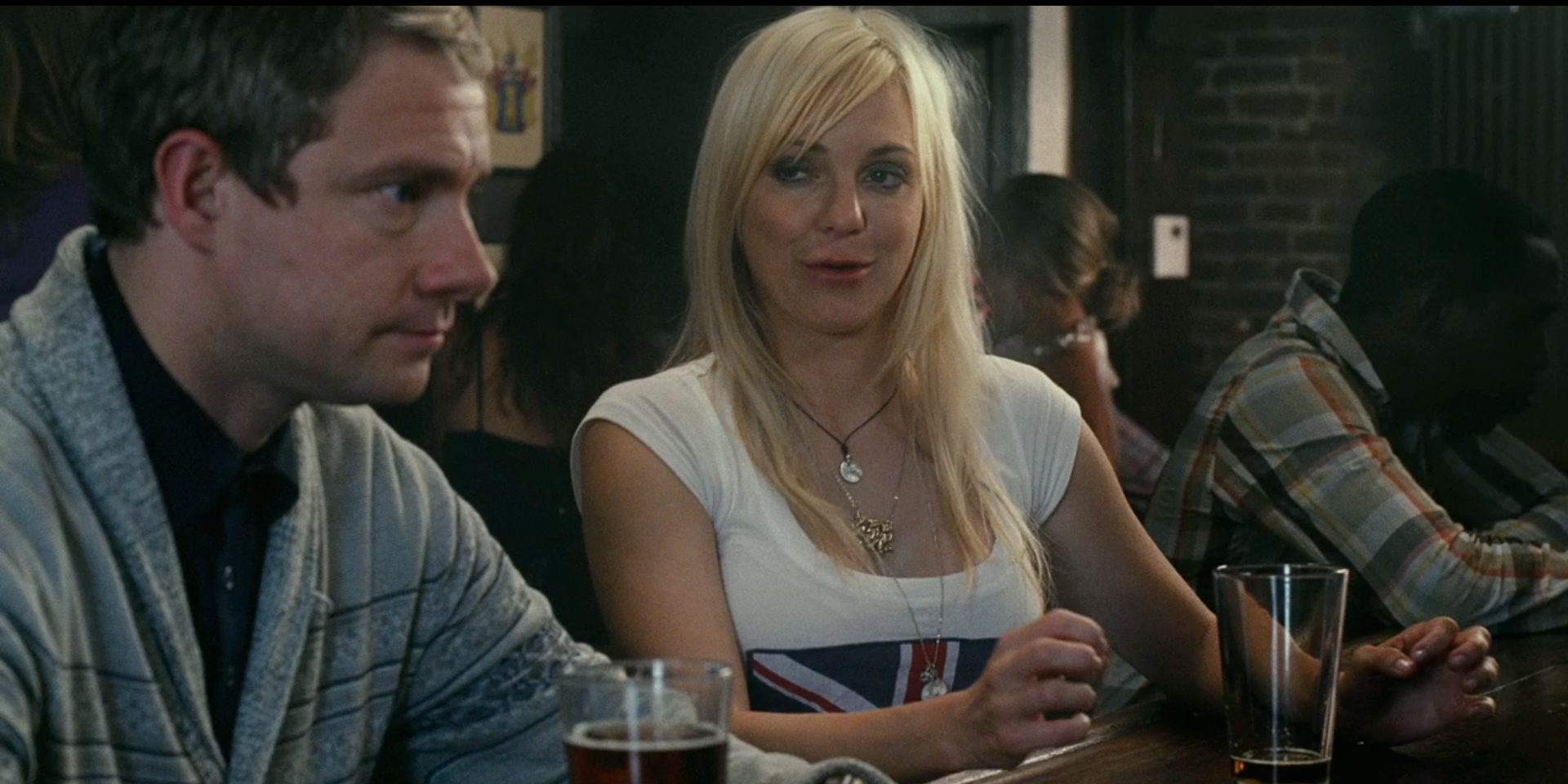
Towards the beginning of the film, as Ally leaves a bar, disgusted to discover one ex-boyfriend remains a bartender, with Colin, the out-of-work musician (although a bartender and unemployed actor in the novel) she concludes the film determined to love forever, she shouts him down over the male’s idealised fantasy of the perfect woman, mother-sister-lover-friend-angel-devil-earth-home. Ally describes her less eloquently, but resolutely insists such a lady does not exist, and Colin is quick to agree. This argument is largely irrelevant, as the movie continues towards a different epiphany that woman are not defined through the eyes of their lovers, or through friends, family or rivals, but by themselves. The scientists at Marie Claire, uptight married friends, possibly charming neighbours and Martin Freeman cannot force Ally to become someone she should not have to become. Through what amounts to an arbitrarily-sketched character arc our heroine comes to the same conclusion, only to learn one drunken night stand never happened, so Colin is her twentieth after all and her whole journey of self-doubt and recrimination was meaningless.

It would be very easy, and probably correct, to dismiss What’s Your Number? as shameful sexism, yet the pressures on modern women come from within. Ally’s two romantic options differ crucially in their reaction to hearing her number, but neither particularly care about who she was, rather who she is, even though who she is never gets explained by the narrative. No one passes moral judgement on Colin’s abundant sexual history or his appalling treatment of women, until Ally, who dismisses him as a pig before sleeping with him. Colin’s attraction to Ally is purely physical, and his developing social interest grows from their proximity, her seeing his lifestyle means it is impossible for him to lie to her. They aren’t so much soul-mates as flatmates, wise to each other’s distortions.

The audience will learn nothing from the film, or Ally’s revelation, because it is shallow, obvious and played for laughs. Mostly, however, What’s Your Number? has no resemblance to the real world and the statistics have been conjured from thin air to benefit the story. An admittedly ten-year-old study stated U.S. women average about four partners, making Ally’s achievement all the more impressive and further burdening her with a moronic social stigma she does not seem too concerned about, until a friend elaborates. ‘In America, 96% of women who have been with 20 or more lovers can’t find a husband,’ she says over drinks in a bar, pulling numbers from the recesses of nowhere. How can anyone relate to anything that isn’t remotely accurate? When you cannot empathise with the characters continued viewing is usually unwarranted, and when the film, book, article uses made-up findings to prove its point a critical evaluation of those results would be obviously misguided.

Tuesday, 17 January 2012

“Connor's boots halted abruptly, and they stared at each other”


Secrets Uncovered brought Donna Alward to Bewildered Heart's attention, as she wrote of black moments, stories dealing with darkness and tragedy in a genre and market seemingly afraid of any kind of unpleasantness. Unfortunately, we were only able to track down Hired by the Cowboy, Alward's 2007 Harlequin debut, a relatively frothy love story set in the mythical land of Canada. The book contains only a few of the challenging elements Alward had attempted to convince us she is famous for. In her opening Dear Reader introduction she hints at the drama soon to unfold. 'If you ask any mother, she'll say unequivocally that she'd do anything for her child.' While her dear readers ponder why anyone would bother to ask then, the author sets up the usual dilemmas and contrivances romance fans expect and appear to insist upon, inter-mingled with a handful of those legendary Donna Alward twists.

Alexis Grayson, Alex to her friends (Hi, Alex!), has no friends to count on when she faces her latest personal crisis. No matter, for this tough, resolutely independent young beauty needs no help from anyone. She has made it thus far without any assistance and she has been getting along pretty well for herself, thank no one very much. Despite her sterling record, at the beginning of Hired by the Cowboy, she is unexpectedly pregnant, working for tips at a smoky bar and unconscious in a convenience store. Awakening to the ruggedly handsome face of a stranger, Alex is embarrassed and thirsty, but quickly forgets such pressing matters due to the gentlemanly conduct of this sharp-suited and extremely good-looking chap. He reassures her, humours her curt quips and resolute independence and then buys her a mug of peppermint tea. Alex does not need his help to figuratively get back on her feet no matter how kind he seems and she does not need his help to literally get back on her feet no matter how sturdy his arms. She will work something out, she always does. Remember when she was jobless and alone she still managed to become impregnated with a baby. She is a survivor, in summary.

Connor Madsen does not like wearing suits, would prefer to not be taking meetings in the city and has little understanding of herbal remedies, but one look at this troubled, yet determined, young woman and he is smitten. Connor has problems of his own. Due to a beef scare of some description he faces the loss of the ranch that has been in his family for generations. With no cash reserves to see him through such a bleak financial forecast he requires the money left to him by his parents in a trust fund. However, he can only access this small fortune when he turns thirty, and his feisty grandmother cannot change the rules. If only there was a statute within the contract that allowed him to acquire the money sooner, say if he was on the verge of losing the ranch? No, but what's that? There is a disclaimer that states if Connor were to get married the money would be released. If only there was a woman in as equally dire circumstances as Connor, who might agree to a marriage of convenience in exchange for a place to live and some help through her, for example, pregnancy and destitution. If only Connor had met such a damsel-in-distress mere pages earlier, who was not only beautiful, but had the good sense to reveal her life story and mention how she could be found at a moments notice.

Connor visits the smoky bar and finds Alex too busy working to hear about a life-changing ultimatum, so instead he waits outside all night with a bunch of flowers, because Connor is nothing if not chivalrous and old-fashioned. Walking her home, he explains the situation and proposes a shotgun wedding, to which Alex responds appropriately. Sensing she may be a tougher nut to crack than she first appeared Connor gives her the opportunity to think it over and suggests a trial period of living together at his isolated farm to see how she likes it, because Connor is nothing if not chivalrous and old-fashioned. When the next day comes Alex tentatively accepts the offer, because there is nothing a mother would not do for her child, and also because Connor opens doors for her, worries about her well-being and has thick-eyelashes, the masculine triad of goodness. Soon after they begin the drive to Canadian cattle country and a hearty spot of lunch from Connor's plentifully-stocked refrigerator. They make sandwiches amidst heavy erotic tension and light social awkwardness. Before long, the man must go out to tend to the livestock, so the woman makes herself at home and begins to think what she will make for dinner and how else she can please the man who will pay her to marry him.

Plot points are signalled when Alex finds a photograph, strewn haphazardly for all the world to see on the dresser of Connor's bedroom behind a closed door, and there ends the third chapter. For the publishers at Mills & Boon, Donna Alward's novel offers great potential, while never straying far from convention. The plot itself is a loose reworking of Solicititilation, but within the cuddly confines of Romance Romance the manipulative, misogynistic billionaire becomes a struggling, noble cow-hand and the recently unemployed, yet ambitious, female yuppie becomes seriously down-on-her-luck and pregnant. These superficial alterations are all that separate Hired by the Cowboy from the likes of Taken by the Sheikh or The Billionaire's Housekeeper Mistress. For Alexis the chance to play house, to cook and clean, look after a man and think only of her offspring is a welcome relief, having for years had to live within the gritty urbanity of Ontario. Thus her desire for feminine domesticity has been suspiciously embedded in character to avoid the understandable accusations of sexism. Alexis is an atypical heroine, but not necessarily a convincing one. Her pregnancy might be her defining feature, but it is utilised solely to make her acceptance of Connor's offer believable, much like Stacy's unemployment and tragic past allowed the reader to not judge her harshly for agreeing to The Millionaire's Indecent Proposal. As expected, due to the demands of the subgenres, Alex's situation allows for heightened drama while Stacy's befitted all those oily rubdowns and endless sex scenes.

Even at this early stage the reader will have no difficulty predicting the narrative turns toward this fixed marriage becoming a very real one. The blurb hints at airborne love, but there is no implication of conflict or tension. Has Alex made her biggest ever mistake by marrying the man she wants to spend the rest of her life with? the blurb asks, over-enthusiastically. It appears as if Alward can easily resolve her story without resorting to her favoured tactics of miscarriage, domestic violence or limb-losing. At this point, however, there is the nagging issue of Alex's baby and the matter of said child's conception. As with every Cherish title that involves a single parent, including The Dad Next Door, we are left to ponder where the father is, how he will further complicate the scenario and where has he been all this time? Will Connor seek him out, duty-bound and noble as ever, and will Alward develop a powerful, poignant human love triangle to make those last two hundred pages fly by? With an author seemingly so willing to embrace her every homicidal fantasy we cannot rule out genuine heartbreak, resulting in a happy ending all the more satisfying and fulfilling, but given Harlequin Mills & Boon's history, perhaps the reader should look forward to everything ending neatly without the author giving any thought to properly dealing with the issues raised by the narrative, something we should assume Alward is equally well-known for.

Thursday, 5 January 2012

“Was he so perverted that he would risk death rather than be denied his sick pleasure?”

During our initial three trawls through the quagmire of wisdom that is Secrets Uncovered we learned of the basic elements involved in creating conflict for story-telling purposes. Following on from those lessons comes another fundamental insight, 'Emotional conflict needs to be emotionally impactful,' at least so say the editors at Romance HQ. However, these same editors proffer a warning that too much emotion will see your manuscript rejected just as easily as if you had not bothered with emotion at all. There is a careful balancing act to be performed, so your reader will be invested in your story and the journeys of your characters, but will never become afraid that something dramatic, or sad, is forthcoming, to shatter the warm buzz of romance and alcohol. Searching for additional insight, RIVA author Fiona Harper was drafted in to throw around her own experiences. 'New writers often make the mistake of thinking that emotion on the page is the same as drama on the page. However, too much high emotion can turn readers off just as quickly as too little emotion.' Once sense has been deciphered from that quote we are forced to ask, is this an implied call for subtlety, from the author of English Lord, Ordinary Lady and Swept Off Her Stilettos?

Ignoring that as skilfully as we have grown accustomed to, we move along. 'Too many manuscripts from aspiring authors feature heroes and heroines who are emotionally incontinent. You know the sort – the ones that just have to let it all out every time they get the urge! Toddlers might behave this way, but mature adults don’t. Or shouldn’t.' Until toddler romance fiction catches on a potential writer is best served reinventing the Mills & Boon standard with the introduction of mature adults, so long as mature means a woman no older than thirty and a man a few years older than his prospective bride, both of whom severely repressed because of previous relationships and unresolved issues with their parents. Now, instead of all this womanly talk of openly sharing, empathy and gin, we should embrace an era of heroes and heroines barely able to control their tempers, passions and other dangerous tendencies. 'Often, the most emotional scenes are the ones where a character struggles to keep a lid on their feelings. If your character doesn’t cry, your reader will.'

Therefore, the mental breakdowns of your protagonists must be carefully-structured, a deliberate-yet-inevitable build-up to forsaking all else for the love of a heartbroken cowboy billionaire recently returned from war. 'If you overdo the drama, you risk exhausting readers and they’ll switch off. Connection broken. Book put down. Also, if you use all your emotional ammunition on scenes that don’t need it you’ll have nowhere to go when the real emotional high points come.' Sound advice to many hopeful Mills & Boon fans, who must have no idea what they are doing in their new careers. There is an obvious pitfall to all this angst, hardship and crying, however. How much is too much and don't readers just want a hunky, yet egocentric, billionaire, a happy ending, a few sex scenes and about forty thousand words of padding? Surely depression, politics, addictions, heartbreak and brutal murder are at best ill-advised and at worst completely unjustifiable when telling the tale of two idiots falling in love against a backdrop of exotic paradise, or small-town America.

In what Bewildered Heart has chosen to describe as research we have witnessed the odd murder, the kidnap of a baby, the accidental death of a toddler, casual sexual assault, war and journalists in our past experiences with romance fiction. In the majority of those examples the serious issues felt unsuitable due to the superficial treatment they received in a character's back-story for present-day motivation. Despite this prescient warning, Secrets Uncovered turned to a self-proclaimed author of feel-good, emotional stories for Cherish, the sub-genre known to Bewildered Heart as Romance Romance. Donna Alward was more than happy to take some time away from fetishising cowboys to explain how to balance dark themes with inoffensive loving. 'There are times I walk a really fine line between deeply emotional and depressing. Let me say right now, if you have these tendencies, embrace them. It’s not a bad thing.' Fair enough, Donna Alward, but what kinds of gloomy tendencies should we expect from A Family For the Rugged Rancher, Honeymoon With the Rancher, or other depressing-sounding titles featuring ranchers?

'I’ve dealt with the death of a baby, miscarriage, physical disfigurement, post-traumatic stress disorder, physical abuse… I do emotional trauma.' There is nothing wrong with the big issues that plague the everyday lives of everyday people, and if Alward's books contain those traumas within the context of the stories, rather than as prehistoric scarring, then kudos to her. How does Donna do it then, and could she possibly tell us while skilfully publicising one of her own recent novels? 'I’m going to use my book Her Lone Cowboy as an example.' Well played. 'Noah is home from Afghanistan where he lost his right arm in combat. From the start I knew that he could be down but not out. He needed to be fighting to get his life back and reaching for a goal which may or may not be happiness.' Self-pity is not attractive, as most of us learn the hard way, and therefore Noah grasps heroically, albeit vaguely, for an objective that can be held in one hand. We can surely predict that his objective will involve a loving woman and maybe a ranch, with some horses.

The secret to Alward's definition of success? 'It’s about going deep. The conflict is not the issue, but it is easy to confuse the two. It is not that he has lost his arm and needs to adjust. It’s the ripple effect: his loss of identity as a combat leader, finding a new place in the world, reconciling himself to being home and the death of his father, falling in love but being unsure that he is man enough.' Suddenly his missing arm is the least of his troubles, as narrative necessities push it toward the periphery. Certainly, his disability is a telling metaphor for his feelings of emasculation, but Her Lone Cowboy is a poor example of chiaroscuro. The tale of Noah and Lily seems comparable to another Cherish title, The Dad Next Door, which heaped on the tragic crises, and then wasted them on soap opera histrionics. The sadness of losing a child, being jilted and the worst recesses of grief had happened before the story began, and this left the book itself to deal with the less dramatic telling of a coupling, one revelation that proved inconsequential, and the return of a secondary character, which was then dealt with ineptly. Alward's explanation is no showcase of the depth of Harlequin Mills & Boon, but merely proof that the tearjerker-elements should be kept to a non-existent prologue and then only sold under the Cherish banner.

The advice contained within Secrets Uncovered amounts to nothing more than Alward's statement that Noah is, 'Not self-pitying but proactive, always moving forward. A reader cannot cheer for your characters if your characters don’t cheer for themselves.' However, he must be proactive and moving the story forward, not to gain the reader's sympathy, but because he is a romantic hero, and the ostensible protagonist of the novel. With this the Conflict Chapter ends and the readers are left to ponder a few questions. How is our own attempt shaping up in view of these guidelines, and, just as importantly, were any of these guidelines useful? We have learned that our publishers share our dream of one day seeing a one-legged hero accidentally-impregnating a heroine, causing much internal conflict for them both, and while Bewildered Heart and our many followers pursue that immediately clichéd concept, we will examine Donna Alward’s debut Harlequin to see if her writing lives up to her shameless self-promotion. There is a wedding on the front cover and words such as pregnant, gorgeous, temporary and mistake within the blurb, so we can only assume that she learned about depth and ripple effects after Hired by the Cowboy hit the shelves.

Friday, 30 December 2011

“What was it about the words 'alone' and 'with me' that set her heart rocketing into her chest wall?”


Let us argue, purely hypothetically, that your debut Mills & Boon attempt is nearing completion. You have created a compelling heroine, who, in all likelihood, has unresolved issues with her father, money troubles and frizzy hair on especially hot days, and you have matched her with an emotionally-distant, arrogant billionaire whose resolute independence has finally been challenged by the attractive twenty-something marine biologist he has hired to be his live-in housekeeper and blackmailed mistress. Naturally, he never intended to fall in love, but he has been intrigued by how her feistiness and outward loathing could be overcome with weekly cheques and why she insists on wearing hats whenever it is sunny. With a lifetime of wedded bliss and endless baby-making one conversation away your hero manages to overturn the metaphorical apple cart with a display of masculine ego, stupidity, or an unlucky misquote, sure to infuriate both your heroine and your readers.

There remains the toughest scene to render, the showdown and apology, where the man confesses to having been a moron, bastard, pimp, or unfortunately loud when speaking privately, and must come to his sweetheart's window, car, private jet, nightclub bathroom and win her back with a heartfelt plea. The course of true love never runs smoothly, as fans of romance fiction know from reading romance fiction. However, as story-telling requires a dramatic impetus against the pastoral idealisation of pure, overwhelming happiness Secrets Uncovered saw fit to visit RIVA novelist Lucy King for a Grovelling Section in their Conflict Chapter. You, lucky reader, shall now learn of every ingredient needed for this must-have sequence, including the most important one of how to engineer an intelligent, arrogant billionaire into doing something so utterly appalling his only option is to apologise. ‘Ah, who doesn’t love a good grovel? The moment the hero realizes he’s been a fool, tracks the heroine down and begs for forgiveness. An alpha male brought to his knees by love?'

Right on, Lucy King. No one doesn't love a good grovel and no story would be romantic without one. Tell us, how on earth do we create such a scene in the first place? 'Screw up really badly. The worse the screw up, the better the grovel. Let his emotional baggage blind him.' Before aspiring authors become too excited at the myriad of dastardly possibilities open to their hero they should bear in mind that he can do nothing so drastic it cannot be solved with a smouldering sorry and some eye contact. Most often in the assorted Mills & Boon's we have studied this momentary breakdown in relations between hero and heroine is generated by a misunderstanding causing old tensions to flare up. Jealousy, pride or being treated as a prostitute are exacerbated by confusion or seeing her walking with another man, moving her belongings into his mansion without asking, or him continuing to treat her as a prostitute even after they have agreed to fall in love.

What's next? 'Leave. Or make the heroine leave.' Let them save themselves from love. After all, there are plenty more marine biologists in the sea. 'But hang on a moment. Reluctantly force him to re-assess the values he has held all his life, analyse some of the irritatingly valid points the heroine may have made during their last encounter and make him examine his feelings (shudder).' This is called character growth. Every character, besides the protagonist, needs to learn and become more-rounded and decent in order to earn the happy ending they are going to receive no matter what. While our hero continues to tremble violently in brackets, let us ponder how we should go about putting this reinvention of philosophy and long-term objectives into the sentences necessary to achieve the desired finished word count. Lucy King explains the significance of this life-changing epiphany, 'In a burst of clarity he realises that he has behaved like a complete idiot and acknowledges that his life is pointless without the heroine in it.' How this monumental thought process comes so swiftly to save the day, and the novel, may seem too important to merely gloss over on the way towards the Grand Romantic Gesture, but this lack of perception is consistent in all other areas of Secrets Uncovered and so we head onto the next statement.

'Waste no time in rectifying the situation. Make a Grand Emotional Gesture. Explain behaviour. At a push, confess that she might have been right after all. About some things. Possibly. Phew. Sorted.' Without details, explanation of importance, or advice of how to make this work convincingly King's guide sounds improbably easy. While the dramatic grovel offers a fine opportunity for sweeping romantic actions, the hero's sudden change of heart, and personality, simply works against everything else we have learned about writing romance fiction. There are merely two shades to the hero, as an epiphany turns him from an arrogant, misogynistic tycoon to a sensitive philanthropist who cannot make a decision without first consulting his wife. The fifty-five thousand words are split, unequally, with fifty-thousand of him being an irresistible jerk and a climatic chapter showing him in the midst of renaissance. This structure ruins the insights of a nuanced journey towards healthy new man of domesticity and fatherhood, and suggests a writer requires fifty thousand words to establish this man as a pillock.

'Wait a second.' What now, Lucy King? 'Something isn’t right.' You're gosh darn right something isn't right. 'Why isn’t she falling into his arms in gratitude?' Is it possible the heroine is smarter than she looks and has been written? Will her handsome owner have to go a step further and explain the plot even more heavy-handedly than the author had been doing throughout the book? Must he, 'Release all those emotions he didn’t even know he had, and take a deep breath and tell her that he loves her and can’t live without her?' Well, it couldn't hurt. Women love hearing that sort of thing. Now we have completed our heartfelt abasement and satisfied all the swooning female readers the world over, there is only the small matter of the heroine accepting this speech as genuine and their lover's arc as accomplished. 'Wait on tenterhooks for the heroine’s reaction.' Still, we know she will forgive, with a womanly smile of victory, and fall into his arms. 'Thank goodness for that. Live happily ever after,' instructs King, lastly.

Thank goodness and live happily ever after, indeed. For a moment it seemed as if those two would never work things out, so stubborn and made for each other as they were that not even their love could overcome an author rigorously committed to a pre-approved structure. In many cases the initial plot contrivance, or screw-up to use King's expert jargon, that prompted this narrative twist would either be too horrific for an apology to suffice, in which case the writer should begin their novel over, or be accidental, incidental or insignificant enough to be appropriate for Mills & Boon publication. Hearty congratulations to you, prospective authors, either way.